
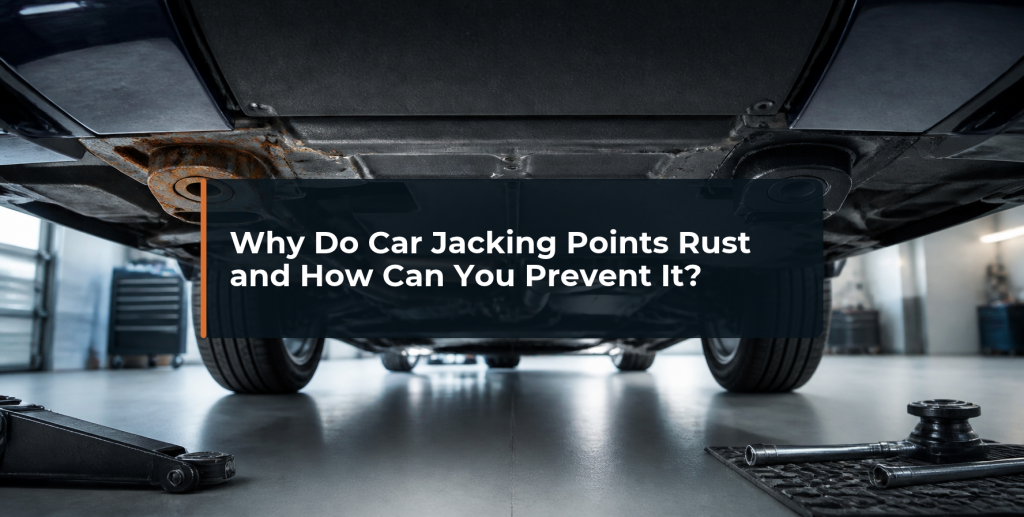
Car jacking points are easy to overlook until a tyre needs changing or a garage lifts the vehicle. Yet these small areas beneath the bodywork are exposed to water, grit, road salt and occasional damage from lifting equipment. When their protective finish breaks down, corrosion can develop around the metal that supports a vehicle during lifting.
Not every rusty jacking point is unsafe. However, deterioration in the surrounding sill, reinforcement or structural mounting area deserves attention. Knowing what to look for, and when to stop using a lifting point, can prevent an avoidable safety problem.
Jacking points are manufacturer-specified lifting locations, including reinforced sill sections, brackets or subframe points. Roadside-jack points may differ from workshop-lift points.
Because many are close to the road, they can be exposed to spray and debris. Some are also located near seams, folds or enclosed sill sections where moisture may linger. Always follow the vehicle handbook rather than assuming every visible flange or metal bracket is a safe lifting point.
A lifting pad that is incorrectly positioned, unsuitable for the vehicle or used without the specified adapter can scrape paint, distort a flange or damage underbody protection. Even small breaks in the coating may expose steel to moisture and oxygen. Repeated lifting can make existing damage worse.
During Scottish winters, salty road spray reaches the underside, including sills and lifting areas. Salt dissolved in water increases the rate at which exposed steel can corrode. Residue may remain in seams even after the visible underside looks dry.
Dirt can accumulate around sill edges, jacking-point brackets and behind nearby trim. Wet deposits slow drying, while blocked drainage openings can allow water to remain inside sill sections. Clearing contamination is useful, but drainage openings must not be sealed over during treatment.
Seam sealers, paint and protective coatings can deteriorate or become damaged over time. Previous accident repairs, poorly finished welding or unsuitable coatings may also leave vulnerable areas. A fresh-looking layer of underseal does not necessarily confirm that the metal underneath is sound.
An inspection should start with the vehicle parked securely on level ground. You can look at accessible areas with a torch without crawling beneath an unsupported vehicle. Signs worth investigating include orange-brown staining, bubbling paint, lifting seam sealer, flaking metal, swelling around a sill seam and visible holes.
Also look for bent or crushed pinch welds, unusual deformation around the lifting area and damp debris trapped nearby. Photographs taken over time can help you identify changes, although they cannot establish structural strength.
Do not test a suspect jacking point by lifting the vehicle or stabbing the metal with a screwdriver. If there is any doubt about its condition, have a qualified technician inspect it using an appropriate, alternative lifting method.
Light surface staining on otherwise sound metal is different from deep pitting, delamination, perforation or deterioration of a reinforced sill. Surface corrosion may be suitable for cleaning, preparation and protective treatment. More advanced corrosion may require removal of damaged material and a properly designed repair.
A technician must assess the affected structure and deterioration. Covering weakened metal with underseal does not restore its strength.
Read the DVSA MOT inspection manual: structural integrity and corrosion
Minor corrosion on a sound, accessible surface may be treated once its extent has been checked. Typically, this involves removing contamination, drying the area, carefully removing loose corrosion, using compatible preparation products where appropriate and reinstating the protective finish.
Follow product instructions and avoid damaging adjacent coatings, brake lines and wiring.
Where corrosion has weakened the jacking point or surrounding structure, repairs must come first. A body repair specialist can determine whether welding or replacement of an affected section is required. Rust proofing is preventative protection, not a structural repair.
The most effective approach combines correct lifting, routine cleaning and inspection with appropriate corrosion protection.
The exterior of a jacking point is only part of the picture. On many vehicles, the sill contains internal panels, seams and reinforcements that are not visible from outside. Moisture can enter these cavities, allowing corrosion to begin on internal surfaces.
A suitable cavity wax can help protect internal metalwork by forming a water-resistant barrier. It complements external underbody protection but does not repair existing structural damage. Treatment should respect manufacturer drainage routes and avoid unsuitable components.
Learn more about where cavity wax is applied on a car
Simply spraying a coating over a rusty jacking point can conceal damage and make later inspection harder. Proper preparation starts with checking the condition of the metal and removing contamination. Loose corrosion and failing coatings should be dealt with appropriately before protection is applied.
Preserve Protect inspects, cleans and prepares vehicles before applying suitable Dinitrol underbody and cavity protection. Structural repairs must come first.
See how Preserve Protect prepares and treats vehicles
Arrange an inspection if the jacking point is visibly distorted, perforated, heavily flaking or surrounded by swollen metal or cracked seams. The same applies if a garage reports difficulty lifting the car safely or identifies deterioration near a structural attachment.
Do not rely on a temporary rust spray, filler or new underseal to make a compromised lifting area safe. Repair work should be assessed and carried out by an appropriately qualified professional before that point is used again.
After sound metal has been restored, a suitable protective treatment can help reduce future exposure to moisture and road salt.
No underbody treatment eliminates the need for inspection. Stone impacts, servicing and routine wear can affect coatings, especially around areas repeatedly used for lifting. Preserve Protect offers free annual inspections for vehicles treated through its rust-proofing service, allowing protection to be reviewed and any necessary top-ups considered.
Find out about annual wax reviews and top-ups
Light staining does not automatically mean a lifting point is unsafe, but visible corrosion can hide deterioration. If there is uncertainty about the metal or surrounding reinforcement, do not use that point until it has been professionally assessed.
No. Underseal helps protect suitable prepared surfaces against further exposure; it does not restore metal strength. Structural corrosion needs appropriate repair before protective coating.
It can, depending on the location, severity and effect on the relevant structure. Not every patch of surface rust is an MOT failure. The official inspection criteria determine how corrosion is assessed.
Check accessible areas periodically, especially after winter or if the vehicle has been lifted for servicing. A professional underbody inspection can identify deterioration that is difficult to see from ground level.
Jacking-point rust often begins with damaged coatings, retained moisture and road salt. Cleaning, correct lifting techniques and early inspection can reduce the risk of deterioration. Where the metal remains sound, professional underbody and cavity protection can help preserve it for the longer term.
If you are concerned about corrosion around the sills or underside, Preserve Protect can assess the vehicle for suitable rust-proofing treatment. Any suspected structural damage should be repaired before protective products are applied.